

Finch Major Street
The proposed development at 179 and 181 Finch Avenue East in North York is a mid-rise residential project that aligns with Toronto's Expanding Housing Options in Neighborhoods (EHON): Major Streets initiative. Located along a designated Major Street, this site represents an ideal opportunity for gentle intensification in a neighborhood context, delivering housing diversity and urban vitality within a modest footprint.
With a total gross floor area of 43,000 square feet and 40 residential units, the development prioritizes family-sized, three-bedroom layouts, directly supporting EHON's objective to fill the "missing middle" gap in the Toronto's housing market. These larger units responds to the growing demand for livable, multi-bedroom options in urban areas, particularly for families seeking to remain in well-connected, low to mid-rise neighborhoods.

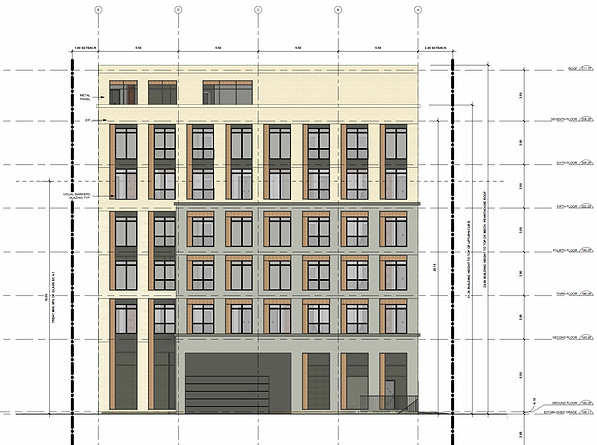
Architecturally, the building employs light-toned precast concreate panels as the primary facade material. This choice delivers a clean, modern aesthetic while maintaining a sense of solidity and permanence that harmonizes with Finch Avenue's evolving streetscape. The building's massing and step-backs have been carefully considered surrounding properties and enhance pedestrian comforts.
A notable design challenge was the limited site depth, which made it unfeasible to include an underground parking garage. As a result, at-grade parking is integrated into the ground floor of the building. To avoid a dead street wall and activate the pedestrian real despite the lack of storefront, an innovative screening system was developed using digitally fabricated perforated aluminum panels.
These panels are not merely functional - they are a key design feature. arranged to form a dynamic, abstracted forest motif, they transform a utilitarian parking facade into a lively, engaging element to the streetscape. During the day, the shadows and patterns animate the street; at night, soft light from the interior filters through the perforations, creating a glowing, artistic presence that adds both beauty and identity to the public realm.
This thoughtful approach not only addresses EHON's requirements for design compatibility and street engagement, but also sets a precedent for how constrained urban infill sites can creatively contribute to public-facing facade design. By treating every surface as an opportunity for architectural expression, the project becomes more than just housing - it becomes a part of the neighborhood's visual and cultural landscape.
The development at 179 and 181 Finch Avenue East is a compelling example of how the EHON Major Street framework can guide context-sensitive, family-oriented, and design-forward housing that enriches Toronto's urban fabric - both functionality and aesthetically.
